
It’s a whale ago but the in 2016 we put together a document outlining how we saw the growth of Milton Keynes should be managed into the future. Having recently re-read the document, much of it holds today.
Blog
-
BBC Politics East 7th Dec 2025
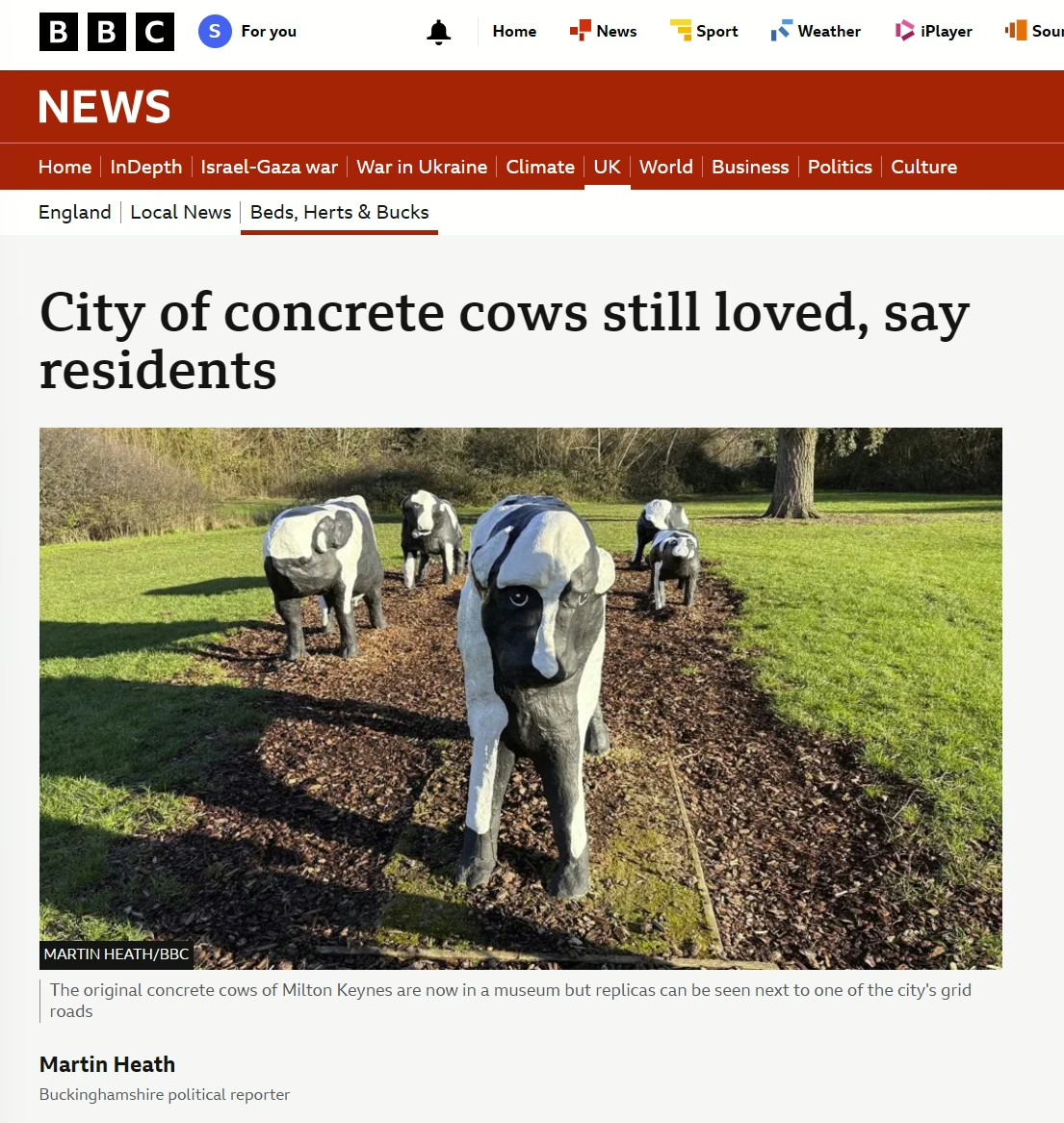
Urban Eden was part of an article about Milton Keynes featured on BBC Politics East on Sunday 7th December 2025. This was followed up by and article on the BBC website. Links below.
BBC iPlayer: Thirty minute programme featuring MK.
BBC Website: City of concrete cows still loved, say residents.
-

What we’re thinking for 2025 and beyond
The 2050 Local Plan for Milton Keynes will be adopted in late 2025 following the final round of consultation. Milton Keynes and the original layout is pretty much bulit out.
Therefore, the scope to pressure ‘the powers that be’ is limited. Our strategy going forward was reviewed in mid 2025 and we are considering a number of options. These deliberations will be completed by the Autumn.
-

Neighbourhood Plans: Now local involvement is totally disregarded
Ten years ago, 89,801 people voted in favour of the Central Milton Keynes Business Neighbourhood Plan. Only 17,133 voted against. The plan was unique because electors in every MK postcode were allowed to vote because of the significance of the central area, as were – also uniquely – all businesses. Of these, 356 voted in favour with 47 against.
The government had instigated, heavily promoted and financially supported Neighbourhood Plans under The Localism Act 2011. CMK’s was given £20,000 and the referendum was a public cost too.
The CMK plan was one of eight government ‘frontrunners’. It was the first to go to referendum and was hailed a success. The government, it seemed, was fully committed to Neighbourhood Plans.
It has now been proved that Neighbourhood Plans were nothing but a sleight of hand. The thinking, clearly, was to pretend that government both national and local cared about local people’s protests to adverse planning decisions and wanted to show voters that they had a way to hear those voices.
Since 2011, thousands of groups of people across the country and – more particularly for this column – in Milton Keynes have invested considerable time and money in preparing Neighbourhood Plans. I was asked to take part in one several years ago but declined because, as you might imagine, I thought it was simply a cynical exercise in perception management.
Sadly, I have been proved right.
Local councils, including Milton Keynes City Council, have in the intervening years ridden roughshod over Neighbourhood Plans. Now, finally, central government has found a way to render them
totally meaningless.Bow Brickhill spent months developing a meaningful Neighbourhood Plan, aiming for sustainable growth of over 25%.
“We secured a grant of about £12,000,” Alan Preen, one of the plan’s fathers, told me. “I attended a residential course in Oxford, and a group of committed residents dedicated months to debating issues, consulting with others, and preparing the plan for adoption.
“This process cost thousands of pounds and countless hours of effort. Now multiply that effort across the country and ask yourself why there is no funding for proper infrastructure.
“Toward the end of the process, architect David Lock called me as chair and told me what would happen to Bow Brickhill. Essentially, our Neighbourhood Plan would be ignored in favour of building several thousand houses and an out-of-village commercial centre.
“Local involvement? Completely disregarded. His message was clear: ‘Don’t waste your time.’”
Alan took the issue to full council. “I dramatically ripped up the plan in front of the councillors and threw it across the floor. That moment exposed the scandal of Milton Keynes’ developers allegedly engaging in “land banking” rather than building much-needed new homes.
“The chair suspended the sitting, effectively ending Bow Brickhill’s democratic voice in Neighbourhood Planning.”
Since then, Bow Brickhill has seen Blind Pond Farm built out with 30 new homes (around six being affordable) that the village supported, followed by a dozen houses opposite, another dozen near Greenways, and over 40 homes currently under construction by Croudace. The population of the village is nearly doubling, with the same infrastructure trying to support it all – except for its Community Hall which the community raised the money for and took the initiative to build.
There are plans for another 2,500 houses between Bow Brickhill and Woburn Sands. It is distinctly possible that Bow Brickhill station will closed in favour of Woburn Sands station, which is being relocated (another scandal), despite Bow Brickhill being the most popular thanks largely to Red Bull staff and children commuting to Bedford.
The fiasco with the railway bridge on V10 Brickhill Street (written about here in previous columns) continues, an example of incredibly poor planning, lack of money, the left hand not knowing what the right is doing and developers trying every which way to fudge a solution and get on and make profit.
“What we are left with is an unsustainable mess: sewers flowing into homes, subsiding land due to neglected ditches and no one taking responsibility,” says Alan. “Meanwhile, it is nearly impossible to get an appointment at the doctor, the roads are riddled with potholes and enormous logistics warehouses remain vacant after two years.
“Heavy rains turn the logistics estate into a wading bird sanctuary due to poor water management and, yes, sewage backs up too. But don’t worry—someone has told someone else and apparently, it’s “not a problem.”
As a world-class cynic this is exactly what I expected would happen but it is still shocking quite how blatant it all is. This is happening not just here but across the country and now, following the current government’s 2025 spending review, ministers have withdrawn all support for Neighbourhood Planning for 2025 onwards.
This includes all new applications. This also includes both the support they provide to community groups (including town and parish councils) preparing or reviewing neighbourhood plans and local authorities to cover referendum and examination costs and so on.
So, it seems that we will not see more easily-deluded voters thinking that their voice in local planning matters carries any weight. In the meantime, I understand that the Society of Local Council Clerks and the National Association of Local Councils are working on updates and further information regarding the future of neighbourhood planning support.
We have all been tricked since 2011. Now the curtain has finally been pulled back by Dorothy (oops, I mean Chancellor Rachel Reeves) and we can see the man pretending to be The Wizard of Oz.
Does he look like a building developer / land banker to you too?
Cheerio.
-

Sound the Death Knell for convenience
The first time I visited California I realised that the Americans were smarter than us Brits in one very particular way. They truly value convenience. Nothing must stand in its way.
Supermarkets must stay open 24 hours a day. Parking must be free, even in limited space car parks where it was necessary to get a shop – any shop – to stamp your card. If there was deal by a company whose goods were stocked at a supermarket, rather than by the supermarket itself, you were told about it automatically at the till.
I recall buying two bottles of potentially “emergency water” for a short trip to the Anza-Borrego Desert with its 600,000 acres of diverse desert terrain, a desert so hot in late August that it was like standing in front of a hairdryer on full blast, whilst the roads were covered with basking snakes.
As I got to the cashier with my two bottles of a particular brand, she said: “I think there’s a two for one offer on those”. She pulled out a page of a newspaper with hundreds of offers, cut out the right one and let me pay for just one bottle.
Can you imagine Tesco, Asda or Sainsbury’s doing that? No, me neither.
This lack of any sense of the necessity of convenience often strikes me here in Milton Keynes. Milton Keynes City Council has recently found new ways to strip out further convenience from our lives.
Suddenly expecting more than one green bin to be collected without incurring an additional fee is no longer an option, despite rises in everybody’s council tax and regardless of the size of your garden.
This move by the council follows other recent slaps in our faces such as having to make an appointment to drive to the tip and to never be allowed to use a trailer or van should you have one.
Not only does the council fail to understand and respect the needs of its citizens; it appears to go out of its way to hurt them both financially and emotionally.
You would think, wouldn’t you, that MKCC’s mission would be to improve the lives of its citizens. It would, you’d imagine, revere and respect the original principles for this city that made it different from and much more user-friendly than virtually everywhere else.
These principles were so clever that the original plans for Milton Keynes have been copied all over the world from Africa to Canada and beyond.
You would hope that MKCC would literally do everything in its power to preserve such elements as 1km grid squares with their own workplaces and shops to avoid a morning and evening ‘rush hour’ to the centre, that they would champion new redways, new grid roads, new grade-separated crossings, reasonable-cost parking where it is absolutely necessary to charge anything.
But no. MKCC is proving itself to be, quite literally, the enemy of its citizenry.
I wonder whether the council has already damaged trade at centre:mk with parking charges and strict ticketing routines. I am willing to bet that the centre would be busier and more successful if parking was still free as it is at other major shopping centres countrywide such as at eight of the biggest shopping centres in the UK:
- Bluewater, in Kent, has 13,000 free parking spaces.
- Meadowhall, Sheffield has 12,000 spaces.
- The Metrocentre in Gateshead is one of the UK’s biggest with 10,000 free spaces.
- Lakeside Shopping Centre at Thurrock offers 11,857 free spaces.
- Trafford Centre in Manchester – in my experience, one of the UK’s best – provides 11,500 free spaces.
- In Glasgow, the Braehead centre has more than 4,600 free spaces. And Silverburn includes more than 3,400.
- Arena Park in Coventry, has 1,600 spaces.
Meanwhile, Milton Keynes City Council has announced plans to remove the last vestige of free parking in central Milton Keynes.
Shortly before you will read this column, a deadline of April 24, 2025, will have passed by which time MKCC will have sought public input via a statutory consultation – input that I can absolutely be certain will be ignored.
It was seeking our views on separate Traffic Regulation Orders to remove all existing car share parking places and free and limited waiting parking places in Central Milton Keynes, replacing each with standard and premium tariff parking places.
“The proposal is based on the results of the Council’s Strategic Review of Parking, a citywide initiative designed to assess parking pressures and to identify areas where parking controls would help to alleviate those pressures,” the council said in its Official Statement of Reasons.
“The proposal aims to manage parking availability and usage to the benefit of residents, businesses and their visitors. This will be achieved by the alteration of a combination of parking restrictions and parking places.”
So it is all for my benefit. Silly me, how could I not see that? How funny, that increased revenue from fees and fines does not get even a mention.
For those of us still able to park for free near the market, for instance, it will be the end of an era. The anti-convenience brigade at MKCC will have one more notch in their belts of pain, one more slap in the face for its citizens, one more way to fine and penalise us all.
And to think that MKCC has its own carpark, right in the heart of CMK and entirely free for councillors. What a happy coincidence.
Cheerio.